


Timely ‘Investment’ is a thought provoking film
 |
Rating: ★★★★
Studio: Indu Enterprise Producer: Mahadwar Story & Director: Ratnakar Matkari Associate Director: Ganesh Matkari Editor: Sagar Vanjari Cast: Tushar Dalvi, Supriya Vinod, Sulabha Deshpande, Sanjay Mone, Sandeep Pathak, Praharsh Maik, Milind Phatak Movie Review by: Ulhas Shirke |
‘Investment’ written and directed by Ratnakar Matkari, has already won National award before its official release. The film also received critical acclaim at various international film festival, during the past few months. Now, its timely release has brought to the notice of the audience not only a socially relevant and hard-hitting subject; but a timely and thought provoking film.
Actually, ‘Investment’ is an extraordinary film, presenting the story of a typical Upwardly working couple Aashish ( Tushar Dalvi) and Prachi ( Supriya Vinod) and their twelve-year old son, Sohel(Parharsh Naik), who is being pampered with more than required care. The mother has a dream of raising her son to be a successful Politician of the Future, a field, which she believes, is promising, due to its lucrative opportunities of growth, power and finance. But, Sohel who turns a spoilt & self-centered brat, wants to follow his father’s footsteps. Only success formula he believes in is, “Achieve, what you wish”.
One day, he sends a love note to his classmate Deepa Gangan, who hails from a totally different social strata. As a result, her father (Sandeep Pathak) informs Ashish and Prachi to keep their son at bay. Prachi takes it as an insult; but Aashish’s old mother (Sulbha Deshpande) who keeps visiting their house; smells some trouble. Very next day, Deepa goes missing and Sohel who is approached by Deepa’s father, tells that he is unaware of her whereabouts. But, when Deepa’s dead body is found by the police; the suspicion points towards Sohel.
It is at this point, the film takes a break for interval, to generate more interest among the audience. In the post interval session, the issues of morality of different characters come to the fore, with the declaration of the actual crime. The film makes a clever statement on the materialistic point of view, with which today’s generation is ignoring moral values. The outcome of the case, signifies the selfish attitude, besides lack of regret of the educated young middle-class. Such disregard for moral values, concludes with a terrible climax of the film. But, that one last scene goes on to say everything; leaving it to the sensible audience to understand the effects of wrong court judgements.
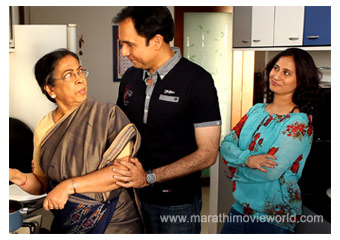
There is no doubt about the strong impact created by the story of this film written by Ratnakar Matkari; but, as a director that too on debut, he has done a very good job. Through the film’s gripping screenplay, he has not only tried to generate curiosity at every moment; but has also sent a strong social message, through the contrast characters of Grand mother and the Mother of the child. The father does have some conscience; as seen through some cleverly shot scenes, but he too turns materialistic, at important situations.
Through the characters of influential criminal lawyer (Sanjay Mone) ,the school principal, class teacher and Police Inspector, the director has lot to convey, about the corrupt existing system. At the same time, through the characters of Sandeep Pathak, Bhagyashree Pane, Milind Pathak and Soham Kolvankar, he has presented the helpless voice of common man fighting for justice.
Except for the terrible climax, which leaves to the audience to decide the fate of such juvenile criminals; the film does send a clear message ‘As you sow, so shall you reap’. There are no songs in this film and therefore you focus on the series of events; which generate a lot of interest at every stage of the screenplay. Cinematography by Amol Gole and clever editing by Sagar Vanjari are other plus points of the film; besides superb realistic performances from all the artistes. A must see film for all..
‘Popat’ delivers social message in a sweet voice
 |
Rating: ★★★ ½
Studio: Mirah Entertainment Producer: Citrus Check Inns Director: Satish Rajwade Story: Chinmay Kelkar Music: Avinash Vishwajeet Cast: Atul Kulkarni, Amey Wagh, Siddharth Menon, Ketan Pawar, Anita Date, Neha Shitole, Megha Ghadge Movie Review by: Ulhas Shirke |
Every film maker has a social responsibility to pass on a message through his film, besides offering entertainment. In the past, film makers like Bhalji Pendharkar, V.Shantaram, Raja Paranjape and many others did it in their own style. Now, young film maker Satish Rajwade joins their group, with his latest offering ‘Popat’.
In today’s time, one really need guts to present such a thought provoking subject, with a commitment to the society. But, Satish has done it very skilfully. No wonder, he is considered one of the talented directors in Marathi film industry today. Incidentally, after doing two films on city lifestyle, this is the first film from Satish, with a village backdrop.
The film revolves around three youngsters Raghu ( Amey wagh), Mukund ( Ketan Pawar) & Bala ( Siddharth Menon) who live in a village Kulpe ( off. Kolhapur) and are best friends. Each one of them possess some skill and it is their common interest in doing something different, binds them together. One day, they decide to make a film on a serious social issue. They catch hold of a videographer Janardan ( Atul kulkarni) from a neighbouring village; who posesses a movie camera. Janardan, who is married to Preeti ( Anita Date), is otherwise a fun loving person and flirts with a tamasha artiste Rakhi ( Megha Ghadge).
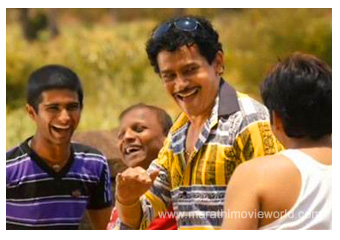
When four of them decide to make a film, scripted by Mukund, Janardan agrees to be part of their project, provided he is offered the lead role. He tries to involve Rakhi into the team; but, doesn’t succeed. Finally, he persuades his own wife( who is carrying) to play his real life wife in this film; besides playing a flirt with Bala’s girlfriend Darshana( Neha Shitole), who is convinced to be part of this film. The efforts of the team seem to be working well; but, while shooting the climax of the film, Janardan tries to back out, fearing that the film’s script is his own story. Finally, ‘all is well’ at the end.
Writer – Director Satish Rajwade has successfully delivered a social message through sugar coated screenplay and dialogues penned by Chinmay kelkar; which almost give a feeling that his imaginary ‘Popat’ has used his sweet voice, to deliver this sensible message to create awareness about a social issue. Many important scenes which are filled with humour are captured very well by the director.
The selection of artistes for the respective roles, make a big difference, in terms of clever presentation at every important situation in the film; be it hospitalisation of the tamasha artiste, Mukund’s father not happy with his son’s activities, the youngsters seeking opinion of housewives about their safety and above all Janardan’s emotion filled reaction during the climax of the film.
Atul Kulkarni has once again proved that he does full justice to the author backed roles. Though in this film, he is part of the group, he has certainly made his presence felt throughout the film. In the roles of three close friends, Ketan Pawar, Amey Wagh and Siddharth Menon find equal opportunity to display their talent. But, it is Ketan Pawar ( ‘Shala’ fame) who steals the show, with his humour filled dialogues. Neha Shitole ( ‘Tu Tithe Mee’ Serial fame) finds better scope in this film, after her performance in ‘Deool’. She has played her role confidently.
In the supporting roles, Anita Date and Megha Ghadge find limited scope. Urmila kanitkar does special appearance during a song sequence. Avinash Vishwajeet’s music is satisfying for three songs in the film. Bhaskar Samla’s cinematography is good. Length of the film ( about 150 mins) is little longer than required; hence stretching few scenes little before interval. But, considering the sincere effort to handle a very relevant timely social issue successfully, the film maker deserves a pat on his shoulder. The film should find its entry at many forthcoming film festivals. And who knows? It may win awards too. Efforts should be made to show this film at touring talkies in rural areas; to serve the purpose of making this film.
‘Govinda’ entertains with a timely message
 |
Rating: ★★★ ½
Studio: Vrindavan Films Entertainment Producer: Vilasrao Waghmode Director: Aatmaram Dharne Music: Rohan Pradhan Cinematography: Nandkumar Patil Cast: Swapnil Joshi, Girija Joshi, Arun Nalawade, Vidhyadhar Joashi, Uday Tikekar, Annapurna Movie Review by: Ulhas Shirke |
Govinda and Ganapati are two such festivals in Maharashtra, which are now days becoming more political than cultural festivals. The shrewd politicians are exploiting the sentiments of enthusiastic youth, luring them with their money power to earn political mileage for themselves. Set on the backdrop of this theme, new Marathi film ‘Govinda’ exposes the motives of one such politician who is more keen on making his own progress in political circle at the cost of the lives of thousands of Govindas, who take risks to rise to maximum heights by forming human pyramids , to win the attractive cash prizes.
Rajan Mayekar ( Swapnil Joshi) is one such dynamic youngster, who is the son of a honest but suspended Police officer( Uday Tikekar); who has been fixed by the builder turned politician Hitesh Gosavi ( Vidyadhar Joshi) , popularly known as Mama. Rajan and his group of friends who are taking lead during Govinda and Ganapati festival in their locality; are lured by the cash prize of Rs. 1 Crore offered by Mama to break the dahi handi.
Rajan has a girlfriend Shravani ( Girija Joshi) living in the neighbourhood; but her father (Arun Nalavade) and Rajan’s father are enemies, always fighting over small issues. Instead of preparing for his MPSC exams, as desired by his father and girl friend; Rajan is more keen on event management. He does not believe in following the path of his father, who has suffered because of his honesty. So, to become richer through fast track, he tries to impress Mama, who is also keen on redeveloping his colony.
However, the shrewd politician, has other plans. When Rajan comes to know the truth about Mama using him for his personal gain and having falsely implicated his father; he dares to challenge him. But, Mama plays all his tricks, only to silence his voice. Finally, after recovering from his leg injury, suffered while breaking Mama’s Hundi, Rajan prepares hard for his examination and becomes strong enough to teach a lesson to the Politician.
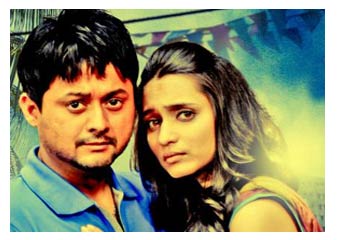
The film deals with a subject, which is so relevant to make the youngsters understand how these politicians are using them for their personal gain, at the cost of their lives. The film clearly hints at the non availability of safety requirements at the site of such prize Money Govinda competitions. It also clearly shows how the Politicians manage media support for their publicity. In one of the scenes, it is clearly shown as to how big water cannons are used to break the pyramids of the team, which is about to break the Hundi. And last but not the least; where from the money comes during Govinda sponsorship ?
‘Govinda’ certainly delivers a timely message at the most appropriate time when the festival season is just on the way; but, some of the scenes have been wrapped up in the screenplay, e.g. like the sudden cancellation of Shravani’s marriage to a boy from Kuwait, followed by quick understanding between Rajan’s and Shravani’s parents. Even the climax scene showing Rajan achieving a powerful position in a short period and getting Mama arrested with his property raided, looks more like a typical formula film style. But, looking at the sincere effort put in by the film maker, in doing a good study about the commercialisation of this popular festival, the film has turned out to be a fairly good presentation .
Swapnil Joshi is now a popular hero of Marathi films. Through his performance in ‘Govinda’ , he has proved that he can pull the success of a film at his own strength. He is certainly a very good actor, who performs every character he plays through his heart and playing this role of Rajan Mayekar with full commitment, is the best example. Swapnil’s fans shouldn’t miss this film. Girija Joshi looks impressive as his co star and has given good support. Considering her character from a typical Middle class family, the director has not glamorized her character.
For both Swapnil and Girija, the director has used light make up, to make them look more natural. Arun Nalawade and Uday Tikekar offer a good support; but Vidyadhar Joshi impresses more, as the perfect villain in Marathi film industry. All the youngsters in the group of Swapnil, have performed very well. Some of them are new faces. Dialogues of the film by Arwind Jagtap are well written. Music by Rohan Pradhan is fine; but, he has impressed more with his background music. Naddkumar Patil’s cinematography has captured the Dahi handi and action scenes and song sequences very well. In short, ‘Govinda’ entertains with a timely message.
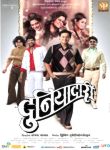
Anything for Love and friendship – ‘Duniyadari’ shows the way
 |
Rating: ★★★ ½
Studio: Video Palace, Dreaming Twenty Four Seven. Producers: Dreaming Twenty Four Seven. Director: Sanjay Jadhav Music: Sameer Saptiskar, Pankaj, Amit Raj Cinematography: Umesh Jadhav Cast: Swapnil Joshi, Ankush Chaudhary, Urmila Kanetkar, Sai Tamhankar, Sandeep Kulkarni, Varsha Usgaonkar, Jitendra Joshi, Sushant Shelar, Uday Tikekar, Uday Sabnis Movie Review by: Ulhas Shirke |
The most valuable gift you can possess is a honest friend. Many a times, some people come into our lives and quickly go; but, some stay for a while and leave footprints on our hearts. Ace Cinematographer turned director Sanjay Jadhav’s latest film ‘Duniyadari’ presents a plot based on such theme, which is inspired from best seller ‘Duniyadari’ by eminent writer Late Shri Suhas Shirwalkar Though primarily set on the backdrop of 1970’s, the happenings in this romantic emotion filled love story, still relates to the youth of today, as screenplay writer Chinmay Mandlekar has made few changes to suit the cinematic form.
So, we find Shreyas Talwalkar (Swapnil Joshi) a young boy in his 20s from Mumbai, caught up in a bad father and mother (Uday Tikekar- Varsha Usgaonkar) relationship. After scoring poor passing marks in graduation, he is sent by his mother to Pune’s S. P. College for his post graduation. He finds his accommodation in college hostel and encounters notorious Digya alias DSP (Ankush Choudhary) and his Katta Gang comprising of Ashkya, Nitys, Sorry, Sunil and Umya, a bunch of hooligans. Digya is in relationship with his long time neighbourhood friend Surekha (Richa Pariyali), who is also part of the gang.
The katta gang members add vibrant colours to the otherwise disturbed life of Shreyas ,who is from a rich family , but deprived of love and friendship. The gang come across a brother and sister duo of Pritam and Shirin (Sushant Shelar and Sai Tamhankar), who are children of a renowned MLA. Pritam who is also student of Post graduate studies, becomes friendly with Shreyas and his other friends, while Shirin who is a medical student, is a frequent visitor to their college. It is actually love at first sight for Shireen, when she first meets Shreyas. The friendship grows. But, in between Digya and his friends suggest Shreyas to become friendly with Police Inspector’s daughter Meenakshi alias Meenu ( Urmila kanitkar Kothare) taking it as a challenge to teach a lesson to her adamant father.
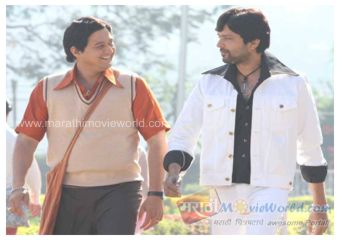
The assembly of these characters is enough for the film to progress with its screenplay with sequence of scenes between Meenu and Shreyas, Shireen and Shreyas, Digya and Sainath alias Sai( Jitendra Joshi) – from a rival gang and local politician’s son. Jealous about the growing friendship between Digya and Shreyas, Akshya breaks away from the group and joins Sai’s group. We also find Sai playing his clever game, proposing Shirin through his political connections. Watching Shreyas coming closer to Meenu, Shirin accepts Sai’s proposal. But, she still tries to be a good friend of Shreyas. Also, with the help of her brother, she brings Meenu closer to Shreyas. Now, in a dilemma, Shreyas declares his love for Meenu , in presence of Shireen; but is not happy. Even Digya finds his beloved getting married to a stranger, at the behest of her parents, who don’t approve Digya.
Many events unfold thereafter, through frequent flashbacks; as the entire story is shown in a series of flashbacks, which is a new style adopted by the director. You also find its link to the story of Shreyas’ mother, who reveals the truth to Shreyas , after his father’s untimely death. It is after that you find a sudden change in attitude of Shreyas, who moves ahead with his changed plan, to take you through a filmy climax .
Director Sanjay Jadhav seems to have paid more attention on presentation of every character from his film, with lot of perfection on their costumes and styles suited to the period of 70s. Watch the bell bottoms of boys, long side locks of Ajinkya, long hair style of Jitendra and costumes of all characters. They are all perfectly styled. What looks unrealistic is the climax, which goes on the lines of Bollywood films of 70s and 80s. Smoking cigarettes by the characters including Shireen-a medical student, has been shown more than required. Her regular visits to S. P. College and that too once in their library looks unnatural. Not much attention has been paid on the make up of the artistes in the older look, except for their grey hair. Even the names of the katta members engraved on the katta, are noticed during the reunion after almost 40-50 years, which is something strange.
But, the fine performances by all the artistes in the film make you overlook these minor errors. ‘Duniyadari’ is a film that mainly revolves around two main characters, Shreyas and Shireen, which is in narrative form from Shireen’s point of view. In the character of Shireen, Sai Tamhankar has found an important role to display her real acting skills. Till now, she was being used more as a glamour girl. Swapnil, was expected to deliver his best and he has played his role with total commitment to his character. His total involvement in the character, can be clearly noticed in this film.
In the role of Digya, Ankush Chaudhary is a perfect choice. He impresses with his tall angry young man looks and actions. Jitendra Joshi presents a rowdy young villain in style, paying more attention on his attire and dialogue delivery. Though Urmila kanitkar kothare finds a limited role, she plays an important character in the film, displaying her emotions clearly. Even Richa Pariyali in her limited role, finds an opportunity in one particular scene, to display her emotions. Sushant Shelar’s Pritam is convincing and so is Ajainkya Joshi’s Ashkya.
In this film, Sandeep Kulkarni surprises with his special appearance. He hardly has 2- 3 scenes; but he creates an impact through them. In the supporting cast, Varsha Usgaonkar, Uday Tikekar and others offer good backing. Music by Sameer Satoskar, Pankaj and Amit Raj is good for a change. Director Sanjay Jadhav has paid complete attention on direction, as he has handed over the responsibility of cinematography to Prasad Bhende in this film, who has done a good job. No wonder, there is sincere effort put in by entire team in presenting this strong script backed film.
Amusing ‘TIME PLEASE – Gosht Lagnanantarchi’ is targeted at young couples
 |
Rating: ★★★
Studio: Everest Entertainment Producers: Anish Jog, Saurabh Gadgil Director: Sameer Vidwans Music: Hrishikesh Kamerkar Cast: Umesh Kamat, Siddharth Jadhav, Priya Bapat-Kamat, Saie Tamhankar Movie Review by: Ulhas Shirke |
Trust in a relationship is everything. Whether it is a friendly relationship or a marriage. Without respect, love is lost. Without caring, love is boring. Without honesty, love is unhappy. Without trust, love is unstable. And life becomes miserable for those who pass through such a strained relationship. Based on this theme, director Sameer Vidwans and script writer Kshitij Patwardhan first presented a Marathi play ‘Nava Gadee Nave Rajya’, which became a hit. The play still draws a good crowd at auditoriums.
Now, the makers of this play have presented a film ‘Time Please! Love story Lagnanantarchi’ by making suitable changes in the script, to suit the cinematic form. So, we find the same lead stars and real life couple Umesh kamat and Priya Bapat, playing the screen couple- Hrishikesh and Amruta in this film, in the company of Siddharth Jadhav as Himmatrao and Saie Tamhankar as Radhika. In the original play the supporting roles were played by Hemant Dhome and Prajakta Datar respectively.
It may be recalled that though the play had its own limitations, the fine performances of the four artistes, their perfect timing and their spontaneous body language created a hilarious comedy. The play reached popularity heights and perhaps that was the reason for giving it a cinematic look. There is no doubt that the director and script writer have taken cinematic liberties to re write the script and add some more scenes to make the film more interesting; i.e. inclusion of songs, one of them being an item number pictured on Siddharth Jadhav and other artistes, during a Bollywood theme party in a unique style.
The film begins well with introduction of the lead characters Hrishikesh and Amruta and creating an atmosphere conducive for the entry of Himmatrao and Radhika, one after the other. But, the re entry of Radhika in the life of Hrishikesh causes more disturbance to Amruta; than return of Siddharth as a good old friend in the life of Amruta, for Hrishikesh. Being much younger to Hrishikesh ( Six year’s difference) causes more misunderstandings between the couple; with Amruta seriously thinking about separation. When their relationship is on the verge of a break, both Himmatrao and Radhika come to their rescue, calling for an happy end.
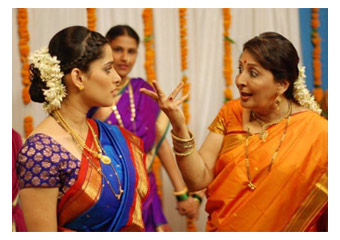
In the film, an unexpected arrival of Himmatrao in the house of the young couple and that too staying for few days, with his kiddish behaviour and closeness with the lady of the house, does create humour ;but, a peculiar scene, when Hrishikesh brings Radhika to his own house, knowing that his wife is away, doesn’t go well. In this scene, he consoles her, after listening to her story and later gives her a Mubnnabhai style Jhappi. Radhika takes this as a hint and walks into his bedroom, when Hrishikesh pushes her back . Then he tries to persuade her to leave, when she is once again into the arms of Hrishikesh. It is at this moment, Amruta walks in by opening the door. Seeing them in such a position, she leaves the house, preparing for a divorce. This looks like a typical filmy scene of misunderstandings.
Actually, there are few flaws in the film, related to unsuitable sequencing of the happenings. But, the timely Dialogues match well with the humour, at appropriate places. All the four artistes in the film have given wonderful performances. Music by Hrishikesh kamerkar is apt at two situations, with one male item number on Siddharth. Even the title song is good. Photography by Abhijit Abdhe is superb. His skilful camera work has captured the close ups and outdoor scenes very well. The last scene at the lighthouse is well taken.
Both Umesh and Priya have worked very hard on their emotional outbursts, besides displaying their happy moments together very naturally. Siddharth Jadhav has proved that his choice was not wrong for the role offered to him. He plays the happy go lucky Himmatrao in his style. In the role of Radhika, Sai Tamhankar is simply superb ! It seems that the film makers have spotted the real talent within her and Radhika is the best suited role for her.
But, why they should show her smoking all the time? Are the film makers not aware of the dangers of smoking among females ? It does pass a wrong message, at a time when Government has imposed anti-tobacco film before the start of such films. Others in the character roles, like Seema Deshmukh, Madhav Abhaynakar and Vandana Gupte have offered good support. This 2 hours 12 minute long film is amusing; but could have been still better, if more convincing outdoor sequences were added into the screenplay, taking the cinematic liberties. The film is timely and does pass a valid message to the young married couples; about the importance of ‘trust’ in each other. It also shows the limitations on involvement of old friends into an individual’s personal life, especially after marriage; unless both the partners know them well.
‘Majhi Shala’ – a stimulating film with a social message
 |
Rating: ★★★ ½
Studio: Passion World Producers: Kiran Deshpande, Ashish Deshpande, Mohan Damle, Sanjeev Langarkande Director:Shantanu Anant Music:Sachin – Deepak Cinematography: Vinayak Jadhav Cast: Arun Nalawad, Alka Kubal, Aaksah Waghmode, Jayant Savarkar, Devendra Dodke, Deepjyoti, Ashok Pawade, Baban Joshi, Sanchit Yadav & Poornima Vawhal Movie Review by: Ulhas Shirke |
Swami Vivekanand once said, “Take up one idea. Make that one idea your life – think of it, dream of it, live on that idea. Let the brain, muscles, nerves, every part of your body, be full of that idea, and just leave every other idea alone. This is the way to success.” Based on this philosophy, new Marathi film ‘Majhi Shala’ has been set on the backdrop of a small village in Khed, Ratnagiri. Ram, a 10 year old son of a farmer in a village, is passionate about taking education and walks miles to take lessons from a village teacher, who teaches poor children from surrounding villages.
When Ram completes his education, he starts educating children from his own small village. Even after his marriage, his wish is to start a full fledged school in the village. Ram spends from his own pocket to promote education in village and attract children to his school. He makes all his efforts, with the help of his wife Savitri, who does laborious jobs; to meet the family expenses. They offer good education to their own son with the hope that he would also join the mission to spread importance of education in the village. However, the son, watching the financial condition of his parents, prefers to take up a job of a teacher in Mumbai. The desire to escape normal life and do something different for the society, keeps Ram’s mind, body and spirit totally involved, to accomplish his mission in life.
It is Ram’s strong wish that keeps him going; and finally we see his dream come true. But, an unfortunate incidence takes place little before interval. However, that does not deter the strong wish of Ram. The film sends a strong message to the society, emphasizing the importance of education in rural parts of India. We have been hearing of Government schemes; but, is the education reaching to the grass root level ? This is what the film has tried to voice through its script. It also throws light on corruption at Panchayat level, raising its ugly head, due to illiteracy in villages.
The film looks like a documentary at the initial stage; but, little before interval writer- director Shantanu Anant Tambe brings a twist into the screenplay, challenging the science and medical field; besides the administration. At the stroke of interval, you get the feeling that the film is over; as the director’s name appears on the screen, instead of the word ‘interval’. But, soon you realise that the dream of the school teacher is yet to be fulfilled. The post interval session is unpredictable, which goes in believing the unbelievable things; only to see the happy end.
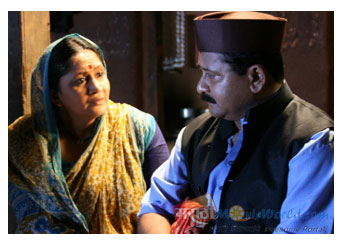
This low budget Marathi film is well presented. But, showing Arun Nalawade and Alka Kubal as newly wed couple in the flashback looks little odd. That is the only drawback of the film. The director could have opted for a young couple instead; as there were not many scenes . There is no doubt about their performances; as both Arun Nalawade and Alka Kubal Athlye have given their best like versatile artistes, through all their emotion filled scenes. In the role of Ram during his childhood, child actor Akash Waghmode has performed well. In the supporting cast, there are equally good performances coming from Jayant Sawarkar, Ashok Pawde, Deepjyoti, Baban Joshi, Sanchit Yadav, Purnima Vaval
Some of the dialogues in the film are hard hitting at neglect of education in rural areas by the Government. MLA of the area is shown more keen on investing in a beer bar in Mumbai, rather than offering financial help to his village school. This is evident from some of the other scenes shown in the film. Background music by Sachin Deepak is well suited to the screenplay. Sound effects are used well with the village backdrop. Cinematography by Vinayak Jadhav has captured the night scenes very well. The director has shown his commitment to the presentation of his own subject. And the artistes have responded well through their notable performances. ‘Majhi Shala’ has thus turned out to be a stimulating film, with a social message.
‘Premsutra’ plays a new game of love
 |
Rating: ★★★
Studio: Kshitij Entertainment, Kathakaar Producer: Rajaram Parmar Director: Tejas Vijay Deoskar Music: Susmit Limaye Cinematography: Pushpank Gawade Cast: Sandeep Kulkarni, Pallavi Subhash, Shruti Marathe, Lokesh Gupte, Shishir Sharma, Ila Bhate, Pradeep Athawale, Prasad Pandit, Subha Khote Movie Review by: Ulhas Shirke |
“Pure love is readiness to give everything, without expecting anything in return.” Sanjay Vijay Deoskar’s new film ‘Premsutra’ revolves around one such theme, which goes on to define love, in its own style. It revolves around a 35 year old Mine Engineer Anand alias Andy Joshi( Sandeep Kulkarni) from Mumbai , who is a bachelor and on a job assignment in picturesque Goa. Andy, is not serious about marriage and is more focussed on his career. He becomes friendly with a young local Christian girl Saniya( Pallavi Subhash) . Initially, it is a good friendship, which moves into bed, with mutual consent . And soon, Saniya gets pregnant.
Saniya does not expect much from Andy in return; but, does keep him informed that she would deliver the child; even if he doesn’t marry her. This scene takes place at a time, when his office colleague Sujit ( Lokesh Gupte) and his Boss’( Shishir Sharma) daughter Malvika( Shruti Marathe) are around. Malvika is for a surprise, as she is deeply in love with Andy and wants to marry him at any cost. But, Sujit who is after Malvika; doesn’t get any response. Back in Mumbai, when Malvika tries to come closer to Andy, he tries to keep her away. Now, desperate to teach Andy a lesson, Malvika marries Sujit; who is just looking for that opportunity to rise above in his career.
But, the Boss has different plans in his mind. In the post interval session, we find all that which we see happen in high society and big corporate houses. It is a real test of Andy, when he gets a tempting offer, with a trap. But, all goes well at the end. With this little less than 2 hour long film; director Sanjay Deoskar has offered a simple, but well presented subject.Having already seen two films during this year, on this topic of Prem( love); this film plays a new game of love.
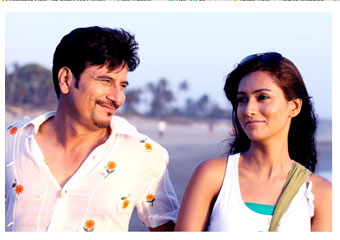
Through the character of Andy, Sandeep Kulkarni has tried to depict the conscience in a typical upright person, with his fine performance in a romantic role ; while Lokesh Guopte through Sujit;’s role , has tried to show the attitude of a selfish person, with complete understanding. His character aspires to become richer, marrying Malvika for his double gain. In the role of Sania, Pallavi Subhash perfectly fits into the character of a young Goan girl, who is willing to take risk in her life, to find her real love. The model turned film actress simply looks stunning, in almost all the scenes and has performed with ease. Shruti Marathe does a fine job to present Malvika- a young female from high society, who feels that money can buy everything . Though she looks pretty in close up scenes, she is found overweight in all those different costumes she displays, in comparison to slim and fit Pallavi.
Restricting the important characters in the form of close relatives of Andy and Saniya, the director has also very cleverly shown the lifestyle of Goa, in comparison to conservative Mumbai culture. Shubha Khote represents a perfect Goan grandmother cum advisor of Sania, while Shishir Sharma plays a shrewd Company chief and selfish father of a demanding daughter.
The chemistry of Sandeep and Pallvi works well with in this film. Their happy moments have been picturised well on the backdrop of picturesque Goa. Shubha Khote has a limited role; but she does make her presence felt. Others in the supporting cast like Ila Bhate, Pradeep Athavale,Prasad Pandit and others have offered good support in their small roles.
Music by Susmit Limaye plays an important role in the film with songs suited to the situations; besides good photography and perfect sound effects. ‘Premsutra’ has therefore turned out to be a clean romantic musical film; for a change.
‘Chandi’ fails to create the original humour in cinematic form
 |
Rating: ★★ ½
Studio: Prabhakar Films Producer: Dnyaneshwar Govekar Director:Sameer Naik, Dnyaneshwar Govekar Music:Pravin Kuwar Cinematography: Sameer Athalye Cast: Ramesh Deo, Dipak Shirke, Vaibhav Mangale, Santosh Pawar, Bhalchandra Kadam, Ganesh Divekar, Sanjeevani Jadhav, Vikas Samudre, Kishori Ambiye, Kishor Nandalaskar, Ashish Rane, Chetan Dalvi, Prabhakar More… Movie Review by: Ulhas Shirke |
Last year, a Marathi film ‘Golaberij’ based on P. L. Deshpande’s popular characters from his stories was released. The film was directed by Kshitij Zarapkar. In that film, the short story of ‘Mhais’ was also there. But, since the makers of ‘Chandi’ who had exclusively acquired the rights of the story of ‘Mhais’, issued legal notice to the makers of ‘Golaberij'; which forced them to delete that particular episode from the film. But, those who attended the press show of ‘Golaberij’ had the privilege of watching that part, which was very well presented.
Now, a year later, we find this much talked about film ‘Chandi’ based on the story of ‘Mhais’ by eminent writer late P. L. Deshpande; being officially released on 14th June 2013, all over Maharashtra. A big hype was created about this film, inviting dignitaries like Shivshahir Babasaheb Purandare & Ms. Vijaya Rajadhyaksha, who showed their physical presence at the Premiere show held at Sun City, Vile Parle on 12th January, which was the death anniversary of P. L. Even MNS Chief Raj Thackeray attended this show, as a special invitee.
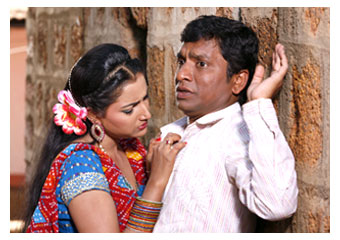
Frankly speaking, the original short story of ‘Mhais’ is based on an incident of a buffalo being knocked down by a State transport Bus, on its way to Mumbai from a village in Konkan. This results in a big show, as the real owner of the buffalo not allowing the Bus to proceed further, till police party arrives for investigation. The situation goes on to show the reactions of the stranded bus passengers and their arguments with villagers, coming in support of the owner of the buffalo.
To present this film in cinematic format, the director duo Sameer Naik & Dnyaneshwar Govekar have taken the liberties to add some more characters, which were not in the original story and hence clearly deviating from the original story. The film begins well with the three characters from a village ‘Savarde’, off Chiplun, on Mumbai Goa highway . So, we find Gaja Khot (Bhau kadam) and Sane (Pradeep Patwardhan) trying to overpower the buffalo owned by Dharma Mandavkar (Prabhakar More), which goes out of control.
In the meantime, we watch the scene at another village, where a senior citizen and well known personality from the village Bapusaheb More( Ramesh Deo) getting ready to proceed to Mumbai, to begin his indefinite fast, over his demand of reviving the Marathi schools in villages. He hires a ST Bus and looks for support from other villagers.
Taking advantage of this situation, different people from the village, take a free ride on the bus to Mumbai to attend to their personal work . So, we find a big team of characters led by Bapusaheb More, followed by chatterbox Dattu( Vaibhav Mangale), his flirt young sister Keshar ( Rupali Bhosale) and a forced character of Gampu, played by Santosh Pawar, to create a place for hero in this film. Writer Anil Pawar has thus taken unnecessary liberties to show the affair of Gampu, besides Keshar also being crazy after him. Finally, the big troupe leave by bus, till it comes to a halt, after knocking down Dharma’s buffalo on the road off. Savarde.
It is at this stage, the original short story of ‘Mhais’ , gets too loud and is stretched too long with unnecessary sequences. The progress of happenings thereafter, clearly indicate that the director duo were running short of ideas to create spontaneous laughter among the audience. You just can’t compare the pleasure of reading the original story with that of watching its cinematic form for little more than two hours, with unnecessary additions. Moreover, the use of mobile phone in the film, brought the film’s story into the present days and that lost the originality.
The only surprise given in the climax is the creation of the original owner of the buffalo, in the form of P.L. Deshpande. Thanks to the special effects team. ‘Chandi’ offers good performances from 86 year old evergreen actor Ramesh Deo. His enthusiasm is to be highly appreciated. Vaibhav Mangale, Bhau kadam, Prabhakar More, Pradeep Patrwardhan, Sanjivani Jadhav, kishori Ambiye & Rupali Bhosale are at their best along with a big team of artistes; but they have not been able to make use of more dialogues over and above the few original jokes of P.L.
You find a big crowd of characters. But, Only Rupali Bhosale finds an author created role, which is most suited to her. Music of this film is just ordinary; but, Sameer Athlye’s cinematography is good. The film just needed that proper attention on its screenplay, which failed to capture the audience. If you compare ‘Chandi’ with ‘Golaberij’, the former was a better presented film with realistic characters. Even that sequence of ‘Mhais’ in that film looked more realistic. ‘Chandi’ has thus turned out to be an average comedy film.
‘Thoda Tujha Thoda Majha’ is a timely film on generation gap
 |
Rating: ★★★ ½
Studio: A. K. Films Producer, Director: Anil Kakade Writers: Anil Kakade, Deepak Bhagwat,Raj Kuber, Natasha Poonawalla Editor: Vijay Kochikar Cinematographer: Ishwar Bidri Cast: Vikram Gokhale, Ajinkya Deo, Sulabha Deshpande, Varsha Usgaonkar, Nikhil Kakade, Swarda Thigale, Natasha Poonawalla, Dr. Vilas Ujawane, Pushkar Jog, Ashok Samarth, Siddharth Jagtap,Neeta Donde,Siddhesh Ghag, Nikunj Hiwarkar,Anand Burad, Radhika Gadgil,Ranjit Randive.. Movie Review by: Ulhas Shirke |
Family is the most important thing in this world. And in Maharashtra, there is a lot of importance for family bond. No matter, today there is a generation gap existing in almost every family; but, the traditional culture in Maharashtra has always kept such families together. Today, we see our new generation following the westernised culture. But, in spite of that today’s wise parents don’t put many restrictions on their children’s movement during late night hours , realizing the pressure of studies and competition they are required to face. However, many a times, it is the bad company of their children, that poses serious problems. New Marathi film ‘Thoda Tujha Thoda Majha’ takes up this most timely sensitive subject, to present a sensible film, involving all the three generations.
Set on the backdrop of Pune city, the film opens up with a raid on a Rave party of youngsters. In that group is a young boy Sameer Sawant( Nikhil Kakade) from a well to do family and only son of his parents Ramesh & Malati Sawant ( Ajinkya Deo and Varsha Usgaonkar) . When Sameer’s father seeks the help of his influential friend and goes to the Police station, to rescue his son, he faces humiliation. It is not only the ACP at the Police station( Ashok Samarth) , who makes him realize his duty as a parent; but also a TV news reporter exposes him. While the boy is released on bail; with the report of the blood samples awaited, the father who feels cheated by his pampered son, drives him out of the house.
Luckily for the boy, his grandparents, who are on a visit to their place, take him along with them, to their native place. The Boy finds a big change in his own self and returns back to Pune, to give a big surprise to his parents on their 25th Wedding Anniversary. But, around this time, the parents receive another news. And that’s the turning point of this film in the climax.
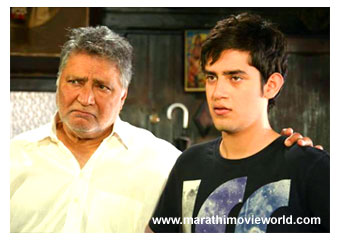
It’s not that films on such subjects haven’t been dealt by Marathi cinema. In the past Smita Talwalkar had presented one such sensible film ‘7 Chya aat Gharat’ , to show how too much of liberty could land youngsters into trouble. ‘Thoda Tujha Thoda Majha’ shows both the sides very well. While showing the concern of parents, it has also shown the point of view of youngsters. Through this film, the film maker has tried to show that it is the proper communication between the youngsters and their parents, could avoid many problems. At the same time, he has also shown how a bad company could land such youngsters from well to do family into trouble.
The youngsters selected in this film are most appropriate choice and look like real final year college students, with their body language and other activities. It is only the young hero of this film, falls short in acting in their company, especially while delivering some of the dialogues . But, at some important situations, while interacting with parents, he seems okay. The sincere effort put in by the film maker in presenting such a timely subject with a message, is to be highly appreciated. In the role of grand parents, both Vikram Gokhale and Sulbha Deshpande have played their parts with perfect understanding, trying to find quick solutions on differences between parents and their only child.
In the role of Sameer’s father, Ajinkya Deo is a perfect choice. He has been able to deliver, what was expected from him, at different situations. Varsha Usgaonkar, who plays a wise mother, looks still beautiful and fit, setting an ideal example before today’s young actresses. In the role of Sameer’s girlfriend, Model turned TV actress Sukhada Thigale (‘Majhe Mann Tujhe Jhale’ fame) does a satisfying debut, though she doesn’t find much scope in this film. Pushkar Jog does a cameo in style, indicating that today’s youngsters pay more attention to their work, rather than formal clothes. Music by Tabi Parik is just fine; but Ishwar Bidri’s photography is something very special. He has captured the beauty of Konkan very nicely. Ashok Samarth plays the aggressive ACP in his typical style, while Dr. Vilas Ujavane plays his part with ease. All others in supporting cast have done a good job.
‘Thoda Tujha Thoda Majha’ is a worth watch for entire family. It has something very important to convey, which is so relevant to parents and their young children.
‘Zapatlela 2′ is more of fantasy than a scary film
 |
Rating: ★★★
Studio: Viacom18 Motion Pictures and Moving Pictures Producer: Adinath Kothare Director: Mahesh Kothare Music: Avdhoot Gupte Cast: Adinath Kothare, Mahesh Kothare, Sonalee Kulkarni, Sai Tamhankar, Makrand Anaspur Movie Review by: Ulhas Shirke |
Known for offering something new through his films, for the past few years, Mahesh kothare has offered more technicalities through his every film, as a director. He has brought a number of innovations, which included first cinemascope film in Marathi through ‘Dhadakebaaz’ followed by Dolby Digital Sound through ‘Chimni Pakhare’ , Computer generated effects through ‘Pachadlela’, Marathi’s first Sci- fi through ‘Zabardast’ and now 3D, Animatronics and state of the art Computer Graphics in the current sequel of his 1993 super hit film ‘Zapatlela’. Therefore, there were high expectations from his new film.
‘Zapatlela 2′ has thus turned out to be more of fantasy than a scary film, as predicted. This time, the stylish actor turned director seemed to have paid more attention on his favourite puppet ‘Tatya Vinchoo’ and the situation arising after his resuscitation in the beginning of the film. In this second part, we find Kubadya Khavis (Abhijit Chavan) visiting a museum in search of this puppet and after finding it, takes it Baba Chamatkar (Raghvendra Kadkol) to revive him, as the puppet lies lifeless for years, after being shot by Police Officer Mahesh Jadhav in the prequel. He succeeds in doing it; and tries to finish Baba Chamatkar but in the process he dies. Baba Chamatkar goes into Coma.
In the meanwhile, Tatya Vinchoo learning about Lakshya’s death, comes to know that he can enter the soul of his son Adi (Adinath Kothare) who lives with his Grandmother (Madhu Kambikar) in Shrirangpur. It’s time for annual fair at Shrirangpur and there are people like Champa Satarkar (Vishakha Subhedar) camping with her Lavani in a tent house and famous ventriloquist Makarand Watvate (Makarand Anaspure) performing his shows. Adi meets Champa Satarkar’s mod daughter Megha (Sonalee Kulkarni) who studies in Fergusson College and is with her mother for vacation. It’s love at first sight for both. On the other side, Makarand falls in love with visiting TV Journalist (Saie Tamhankar). Adi is also attracted to the art of Makarand, as his father once practiced this profession.
In the film, Tatya Vinchoo’s journey towards his target begins with his first interaction with Saie Tamhankar, followed by Makarand Anaspure and finally reaching Adi through the Guard and Sonalee. The director shoots his climax in traditional style at the Giant wheel in the fair. As predicted, we see the end of Tatya Vinchoo, but certainly giving a clue that he would return again. Will there be ‘Zapatlela 3′ ? Let us wait for the announcement.
‘Zapatlela 2′ is a technically sound film, with good use of 3D and special effects, which are attempted for the first time in Marathi; but, the absence of Lakshya Berde is certainly felt. This does not mean that Adinath hasn’t done well. In fact, he has done his level best in that role, in his own style. The otherwise young chocolate Marathi hero, who has given fine performances in films like ‘Dubhang’ and ‘Satarangee Re’ did try to look different with a simple ‘Boy next door’ image; but, frankly speaking, he did not match up with the character he played.
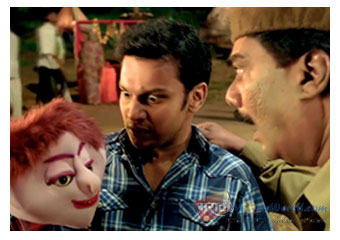
It was felt that to carry forward the humour created by Lakshya, the director should have opted for an actor well versed with comedy. He could have thought of anyone from among ace comedians like Makarand Anaspure, Sanjay Narvekar or even Siddharth Jadhav or Nilesh Sable, if he needed someone young like Adi, to play Lakshya’s son . And the role of Makya could have easily suited Adi, who is shown as the son of late Lakshya (a ventriloquist) in the film.
Very wisely the director has used other characters, including his own character of Mahesh Jadhav ,which was shown as turning Police Chief now, after a gap of 20 years. As a director, he has given enough scope to Sonalee, to exploit her glamour through all those scenes to her share. Makarand’s character should have been developed more, considering its importance in the film. Saie Tamhankar’s character in the film is just namesake, to create a girlfriend for Makarand. In one sequence, she just remains an observer, watching Makrand perform his tricks during the show. Madhu Kambikar as Grandmother, Vishakha Subhedar as Champa Satarkar, Vijay Chavan as Hawaldar promoted as Inspector and Deepak Shirke as the Guard on duty at Makarand’s tent, have performed well.
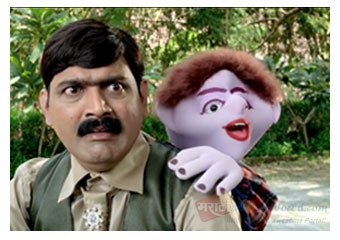
Production designer Nitin Desai has created fine sets suited to different situations and the superb cinematography of Suresh Deshmane makes the film more presentable besides the 3D effect. Avadhoot Gupte’s music is just fine on the lyrics of Guru Thakur.The sound effects have been used well. The work Umesh Jadhav & Phulwa Khamkar as choreographers is clearly noticed, in the Lavani performance by Sonalee. So are the Visual Effects by Enrik Kriyado. The hard work put in by Ramdas Padhye and his son in making of ‘Tatya Vinchoo’ is also to be appreciated.
The film cannot be compared with its prequel; but, is a clean family entertainer for its fantasy part, if viewed in 3D format. Don’t try to find logic in some of the sequences involving the Puppet. After all, it’s the first Marathi film in 3D form and to be appreciated for the effort. The kids would love it, as it is not so scary, as expected. It is certainly better than Bollywood’s ‘Yamla Pagla Deewana -2′ released simultaneously, on the same day.